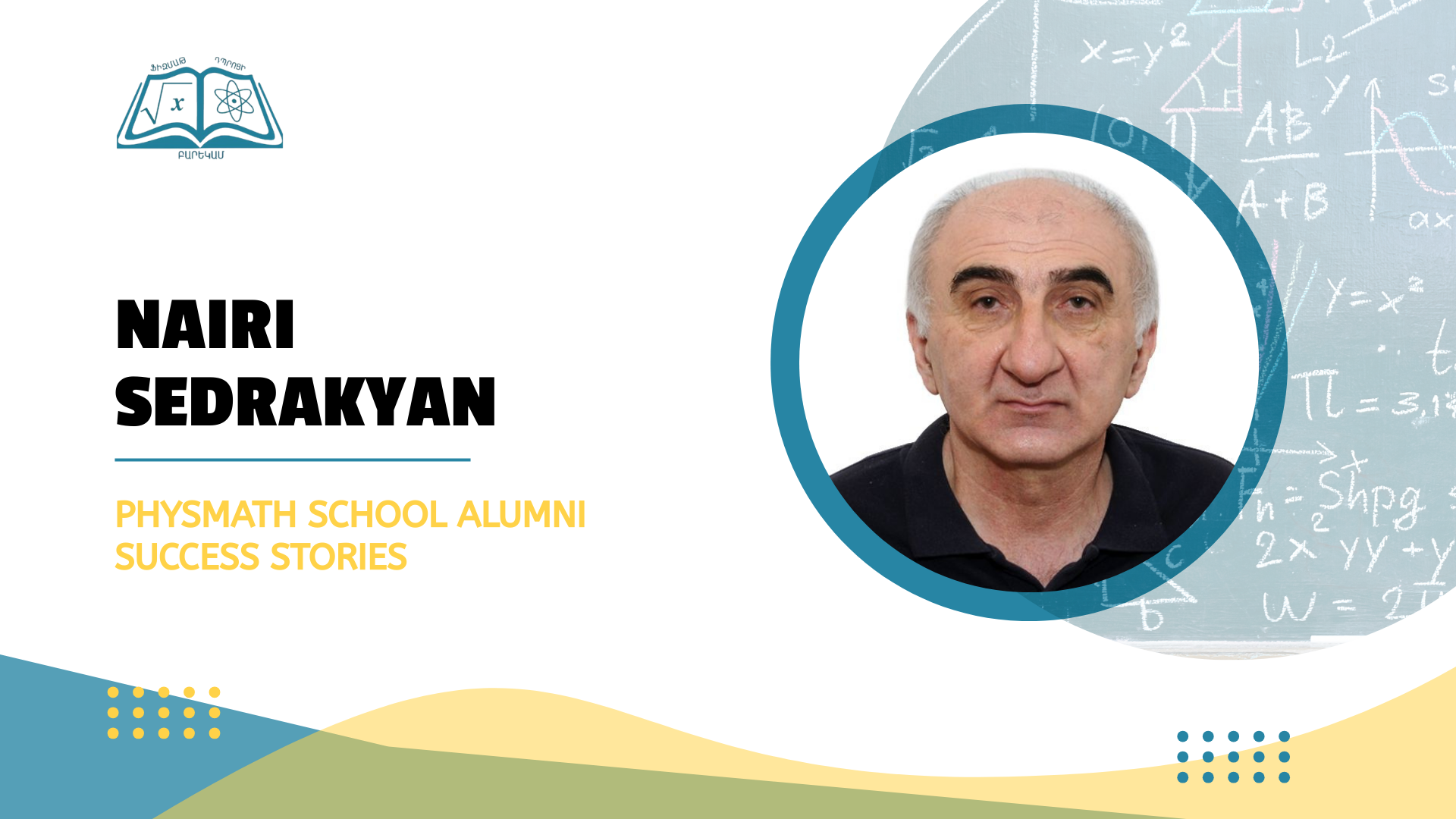
Within the framework of the success stories of PhysMath School students and alumni, we spoke with the renowned mathematician Nairi Sedrakyan. During the interview, Sedrakyan shared insights about his professional journey, the role PhysMath School played in his development, the value of Olympiad education, and his approach to working with students.
– Can you tell us how your journey in the world of mathematics began?
“I first applied to PhysMath School in 1975, taking the entrance exams twice, but I didn’t pass either time. My grandmother always accompanied me to the exams. After my second unsuccessful attempt, she asked the headteacher to admit me, promising that I would study diligently.
At that time, the headteacher was an exceptionally honest man, Hrachik Mkhitaryan. I don’t know why, but he trusted my grandmother’s word and admitted me to PhysMath School. I believe that was one of the greatest strokes of luck in my life.
I was fortunate to have Rafik Martirosyan as my mathematics teacher—a brilliant specialist and educator. Through hard work and Martirosyan’s excellent teaching, I gradually began to understand mathematics. Within five months, I was earning top marks, which felt like a major victory.”
– What memories do you have from your school years?
“I have many wonderful memories from my time at PhysMath. I particularly remember Hovhannes Harutyunyan from Yerevan, who could solve extremely complex mathematical problems. It was astonishing for all of us when, after solving yet another difficult problem, the teacher would say ‘well done’ and then give him a grade of ‘three.’ After seeing that, my own ‘twos’ even began to feel valuable in comparison.”
– In your opinion, what makes PhysMath School unique compared to other schools?
“The uniqueness of PhysMath lies in its highly skilled educators, as well as the exceptionally talented students who study here. There are very few schools in Yerevan where so many gifted children are educated in one place.”
– You’ve been involved with mathematics Olympiads for nearly 50 years. What inspires you the most?
“I particularly enjoy creative work—developing new problems and new ways of posing questions. It becomes even more engaging when this work is done not alone, but together with students. Many of the most fascinating questions come from students’ own innovative solutions.
That is why working with talented children is so important to me. Today, I also teach online classes for students in PhysMath’s Olympiad clubs, which allows me to continue this work in a modern format.”
– What does participating in Olympiads give to students?
“For me, winning an Olympiad is not the main goal. What matters far more is fostering creative thinking in students. Developing this skill is far more important for becoming a mathematician than winning medals.
Dozens of students who studied in my classes have gone on to publish in scientific journals around the world, presenting new problems or solutions that had never been known before.”
– What advice do you always give your students, both for Olympiads and for growing in the field?
“My main advice is to learn how to work effectively with the material being studied. In many cases, two students with almost identical abilities will achieve very different results—not because of talent, but because of their approach to work.
For students participating in Olympiads, I recommend being diligent and patient. Achieving success in these competitions requires a tremendous amount of hard work.”